

Led by Graham Lambkin, avant-rock minimalists the Shadow Ring constructed a strange, lo-fi sound built on folk, experimental noise (from both guitar and electronics), tape loops, and spoken-word poetry. Formed in Cheriton, Kent, England, the Shadow Ring initially consisted of guitarist Lambkin and percussionist Daren Harris, with occasional supporting personnel. Forming their own Dry Leaf label, the group made its LP debut with 1993's City Lights, and scored U.S. distribution with the Siltbreeze label for the 1994 follow-up, Put the Music in Its Coffin. It was followed by a 1995 American tour with several Siltbreeze labelmates, including Harry Pussy.
The Shadow Ring - Put The Music In It's Coffin

V-3 - Unbroken Silence

The very first release by Jim Shepard's group V-3. Only ever released on cassette on the small Iron Press label. A few of these songs have been released on other V-3 releases and compilations... you may remember "Inside Outpost" from Tar'd & Further'd.
I unfortunately have not been able to track down a cover for this release. The one above is just one I made. If you have it or any other info on this release, please send it along!
Vertical Slit - Under A Blood Red Lava Lamp

Jim Shepard inaugurated his insular experimentation back in the late '70s with Vertical Slit, a free-ranging, amorphously constructed band that laid out its lattices of scree around the leader's extraordinary guitar constructions. You can hear bits of MC5er Fred "Sonic" Smith, Sonny Sharrock and Can's Michael Karoli in Shepard's alternately piercing and massaging use of feedback, while his lyrics coat everything in sight with overlapping bile and black humor. An array of cassette releases and micro-pressed records — in editions ranging from 100 (Slit and Pre-Slit) to a whopping 300 (The Live EP).
Under A Blood Red Lava Lamp is a live album that captures Vertical Slit in their early period in a show from 1980. While the recording quality is not the best, you can definitely get a sense of the intensity and the quality of material from this band.
Thomas Jefferson Slave Apartments - Negative Guest List 7"

A single released prior to Bait & Switch that contains two tracks from that album plus what is probably the finest TJSA song (and an all out lo-fi classic) "Baboon's Liver".
Thomas Jefferson Slave Apartments - Bait & Switch

After a bevy of cherished singles, Columbus, Ohio's favorite inebriated sons turned out this spit-caked debut full-length. How it managed to find its way out on a major label is anyone's guess, but it nevertheless confirmed Thomas Jefferson Slave Apartments' stature as one of the most excellent rock band's ever to drink and spew its way out of Cowtown's sloppy bars and subterranean clubs. Bait and Switch is punk rock at its snotty, anarchist best, music to both revere (the band was championed by none other than Thurston Moore) and revile (Ron House's cat-screech voice is an acquired taste, to say the least). Depending on where you're standing in the crowd, the album is either fingers on the blackboard or a perfect, thrilling sort of mess. Skanky, violent venues were built precisely for songs like "Is She Shy," "Quarrel With the World," "Negative Guest List," and "You Can't Kill Stupid," all of which hold their own next to the thrilling cover of "Cyclotron" from Cleveland punk legends the Eels. The music is every bit as polarizing and polemical as, say, Rage Against the Machine, but far more satisfyingly resonant and authoritative because its jibes are nondenominational and self-effacing. House mines his traditional obsessions (getting drunk, dissatisfaction, sex, getting drunk) with typically witty and curmudgeonly spite. But scrape off the first layer or two of vitriol, delve beneath all the bluster and sarcasm, and he is surprisingly candid about grave subjects like cancer and death. And if ever there was a deserved guitar hero (just listen to the metal-splintered stylings on "Down to High Street") it is the criminally unheralded Bob Petric. Aside from a "love" tune and the attempted atmospherics of "Contract Dispute" (let's be honest, the Doors TJSA is not), though, Bait and Switch finds the band pissing into the fire, and its fans would have it no other way.
NME C81
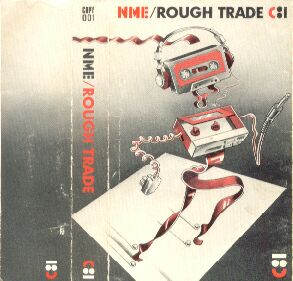
C81 was a cassette that was obtained through the British magazine New Musical Express in 1981 (hence (C)assette 81) and released in conjunction with the record label Rough Trade. Intended to mark the first 5 years of the independent label movement in the UK record industry and Rough Trade itself, it was the first in a series of many cassette releases from the paper, including the C86 compilation of 1986. Publishing a tape was also an acknowledgment of the flourishing self published cassette culture of the time that the NME had been supporting in its short lived Garageland column.
C81 was compiled by NME journalist Roy Carr, and Christopher Rose, who worked in public relations for Rough Trade. To get a copy, NME readers had to collect two coupons from the newspaper and send off £1.50. The 15,000 orders were sold out within a month.[1]
The tape contained a set of 25 diverse tracks ranging from jazz (James Blood Ulmer), poetry (John Cooper Clarke), ska (The Beat), and the folksy 'Canterbury Scene' (Robert Wyatt).[2] British music writer Simon Reynolds called it "post punk's swan song", noting the appearance of three acts from Scottish independent label Postcard Records, and the emerging new pop tendency of bands such as Linx and Scritti Politti.
Pell Mell - It Was A Live Cassette

The "instrumental" stigma has dogged Pell Mell since 1980, when the band was first formed in Portland, Oregon, by drummer Bob Beerman, guitarist Bill Owen, and Arni May, the other original guitarist who worked in a record store in Portland and brought in Jon-Lars Sorenson to play bass. It's not that any of these seemingly well-educated gentlemen were too dimwitted to consider sprucing up their drabby music with a provocative frontman; they auditioned singers in the beginning, and didn't like what they heard. And who can blame them? Singers, with their gaudy necklaces and their unzipped pants and their idiotic gestures, are egomaniacal distractions from the main event - the music. More than drummers, even.
Whether Jimi Hendrix was correct in regarding surf music as a plague upon humanity, Pell Mell were nevertheless perplexed to be continually categorized as such. Truth be told - a novel idea, isn't it? - the band's "vision" was nothing more complicated than the creation of music as cool as all the records coming out at the time by great surf bands such as PiL, Josef K, the Fire Engines, the Feelies, A Certain Ratio, Pere Ubu, the Contortions and others.
Following the recording of the quartet's Rhyming Guitars EP in January 1981, Arni departed, leaving the band to continue as a trio. Bob, Bill and Jon-Lars released the live cassette primarily as promotional and tour-booking tool, but also to distance themselves from the dual-guitar EP, with its newly unplayable songs (except for "Par Avion"). Along with gratifying a shared Duane Eddy fetish, they were trying to fit in with the strong Portland punk scene, and were conscious of what it took to earn an audience's undivided attention. Intentionally designed to keep listeners on their toes, the tracks on (1982) It Was a Live Cassette were written to be played live and are much more aggressive, raw, and abrupt than anything else done by the band since. The more well known, silky smooth quartet (with Greg Freeman on bass, Steve Fisk on keyboards and samples, and Dave Spalding on guitar) was still down the road a piece by a distance of about two years. It was a live cassette and it was all about proving things: that Pell Mell didn't need or want a singer, that they were punk, and, most importantly, that they were not a goddamn surf band.
Tommy Jay - Tall Tales of Trauma

The Long awaited re-issue of the nineteen eighty six Old Age/No Age cassette, Tom's Tall Tales of Trauma. Songs from ten years (out of thirty) of DIY barn and basement classics from Tommy Jay, member/songwriter and co producer of Ego Summit, Mike Rep & the Quotas, and the (Ohio) True Believers.
Tom's Tall Tales is musical dark matter, an unseen cosmic force connecting Ohio punk/folk 4-track 70's experiments to the Cowtown lo-fi explosion of the early 90's and on to today's New Generation of Ohio DIY 4-trackin' freaks.
"He's been my secret weapon all these years-Tommy Jay is he Pavarotti of Punk and so much more."
-Mike "Rep" Hummel
Alastair Galbraith - Mirrorwork

While Alastair Galbraith's particular solo style had long been established by the time Mirrorwork appeared, it was still an approach all his own, often providing wonderful, mysterious results. Certainly the lead track, "For Free," a collaboration with Shayne Carter on "backwards lead guitar," finds his brew of edgy lyrics, delivery, and atypical, hard to grasp melodies as potent as ever, and a good sign for Mirrorwork as a whole. Again, many songs barely touch the two-minute mark, with 24 total tracks in under three quarters of an hour. His home recording style is a collage of electric guitar, violin, and other instruments and overall aesthetic -- again, nothing too surprising to anyone who's heard it before. There's psychotic buzzing on "Rivulets," with keyboards sounding like insane, annoyed bees, and the high-pitched squeals, just a hair away from being annoying, while on "Frostfish" there are two instances of Galbraith seeing how far he can go. Where the joy of Mirrorwork comes in is how he works that combination to his own ends, coming up with some new, intriguing results. The combination of soft and clattering has been done before, for instance, but "Ludd," with prominent acoustic guitar in one speaker and various feedback growls and random noises in the other, is one of Galbraith's best balances between the two extremes. Other standouts include the reversed guitar snippets and loops of "Song to the Third," softly fading away into the distance, and the burbling organ/muttering vocal blend of "Vinyl Curtain," one of his dreamiest yet disturbed numbers. The album's other collaboration, "This Hard," with regular Galbraith partner David Mitchell, finds them both taking the acoustic route, resulting in a quietly enjoyable gem. This occasional tendency to play things completely straight results in such listenable worthies as "Blue Room," played on what sounds like 12-string acoustic, and the semi-blues lope and growl of "Stealthy."
Tobin Sprout - Moonflower Plastic

Shortly after the release of his solo debut, Carnival Boy, Tobin Sprout officially left Guided by Voices to concentrate on his solo career. The cryptically titled Moonflower Plastic (Welcome to My Wigwam) was the first album he released after leaving the band, and unlike its predecessor, it established Sprout as an entity separate from Guided by Voices. Where Carnival Boy was essentially a GBV album in miniature, Moonflower Plastic works from that band's signature lo-fi art-pop foundation and opens up the formula. The songs here are richer and more fully realized. They take time to make their point, and are supported by more detailed arrangements; several tracks even feature piano, and Sprout's voice is richer than before. Similarly, his songwriting is prettier and more affecting. He hasn't abandoned the lo-fi aesthetic -- there are still layers of hiss, and the recording is charmingly amateurish -- but he has invested it with an emotional sincerity that rivals Lou Barlow. Moonflower Plastic still has some slow spots, but the best moments find Sprout coming into his own as a songwriter and musician.
Subscribe to:
Posts (Atom)